Bulgaria’s battery fleet is set to overtake the country’s coal plants in power capacity
Bulgaria is expected to have about 5 GW of battery power and 14–20 GWh of storage by the end of 2026, according to a report cited by fakti.bg. The buildout is reshaping electricity trading, absorbing cheap daytime solar generation and supplying the grid during higher-priced evening hours.
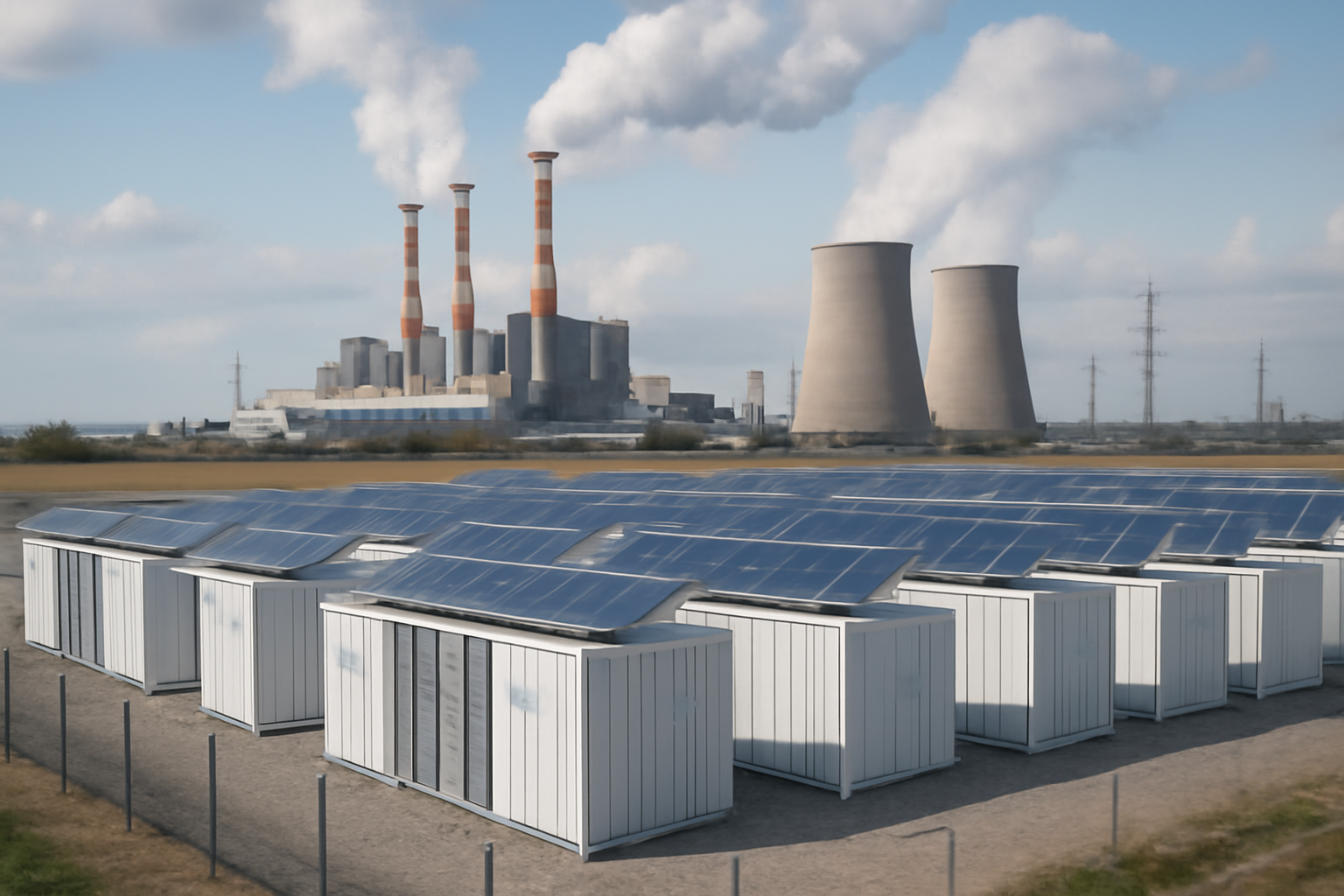
A 5 GW battery fleet emerges in two years
Bulgaria has moved from almost no grid-scale batteries to one of Europe’s fastest-growing industrial storage markets in two years, according to a report by Klimateka cited by fakti.bg. By the end of 2026, installations are expected to reach about 5 GW of power and between 14 and 20 GWh of storage. The forecast remains fluid because new projects are connecting almost continuously.
Power and energy capacity measure different functions. The projected 5 GW indicates how quickly the fleet can deliver stored electricity, while 20 GWh describes how much it can hold. At 5 GW, batteries could provide more instantaneous power than all Bulgarian coal plants combined. The figure also exceeds the combined maximum output of the 2.2 GW Kozloduy nuclear plant, the 1.67 GW Maritsa East 2 coal plant, the 0.9 GW ContourGlobal plant and one unit at Bobov Dol, although this comparison does not include pumped-storage hydropower.
A storage volume of 20 GWh is approximately equal to the electricity produced by one Kozloduy unit over 20 hours. It is also about 34% more than Maritsa East 2 could generate in 24 hours at maximum load, an operating level the plant almost never reaches in practice.
Daytime solar power moves into the evening market
The batteries’ most visible commercial role is to store low-cost solar electricity during the day and discharge it during morning and evening demand peaks. Bulgaria previously had abundant cheap daytime power that struggled to find buyers, while higher evening demand sometimes required imports of more expensive electricity.
Storage is changing that pattern. Market participants can import cheaper daytime electricity, store it and use it domestically or export power in the evening when prices are substantially higher. Battery charging has continued setting records even though the annual solar peak occurred at the end of June. The report attributes the increase to the growing battery fleet and reduced curtailment of solar plants, rather than to stronger sunlight.
The effects extend across the interconnected Bulgarian, Greek and Romanian markets. Limited cross-border capacity can still separate prices. On some days, batteries retained more cheap electricity in Bulgaria and Greece, while Romanian evening prices stayed higher because exports to Romania could not be increased.
Storage takes on grid-support functions
Industrial batteries can switch almost instantly between charging and discharging, helping compensate for load fluctuations and control active power for primary frequency regulation. They can also support reactive-power management, provide digital inertia and enable black starts, allowing generators to restart after a complete transmission-grid failure.
Programmer and data analyst Ivan Yonchovski has created a platform combining information from Bulgaria’s Electricity System Operator and the Independent Bulgarian Energy Exchange. It shows import and export patterns, battery charging and discharging, and changes in the hours when cross-border flows occur.
Private investment changes the storage market
Fakti.bg reports that the expansion is being driven largely by private investors and European financing, rather than an extensive national intervention programme. Rapid project decisions have accelerated connections, although the growing fleet raises questions about the future operating role of pumped-storage plants.
After repairs, the two operating pumped-storage turbines, with combined power of about 400 MW, generally run for only 4–5 hours per day despite theoretically being able to operate longer with the available water. No definitive explanation has been established. For producers, traders and grid operators, the immediate result is a more flexible system in which the timing of generation and consumption is becoming as commercially important as total electricity output.