Brazil closes 2025/26 with record 3.37 million tonnes of cotton exports, up 19%
Brazil shipped a record 3.37 million tonnes of cotton in the 2025/26 commercial year, 19% more than the previous cycle and more than double the volume of four years earlier. China took 770,500 tonnes and India more than 350,000 tonnes, while the sector debates where the next round of export growth will come from.
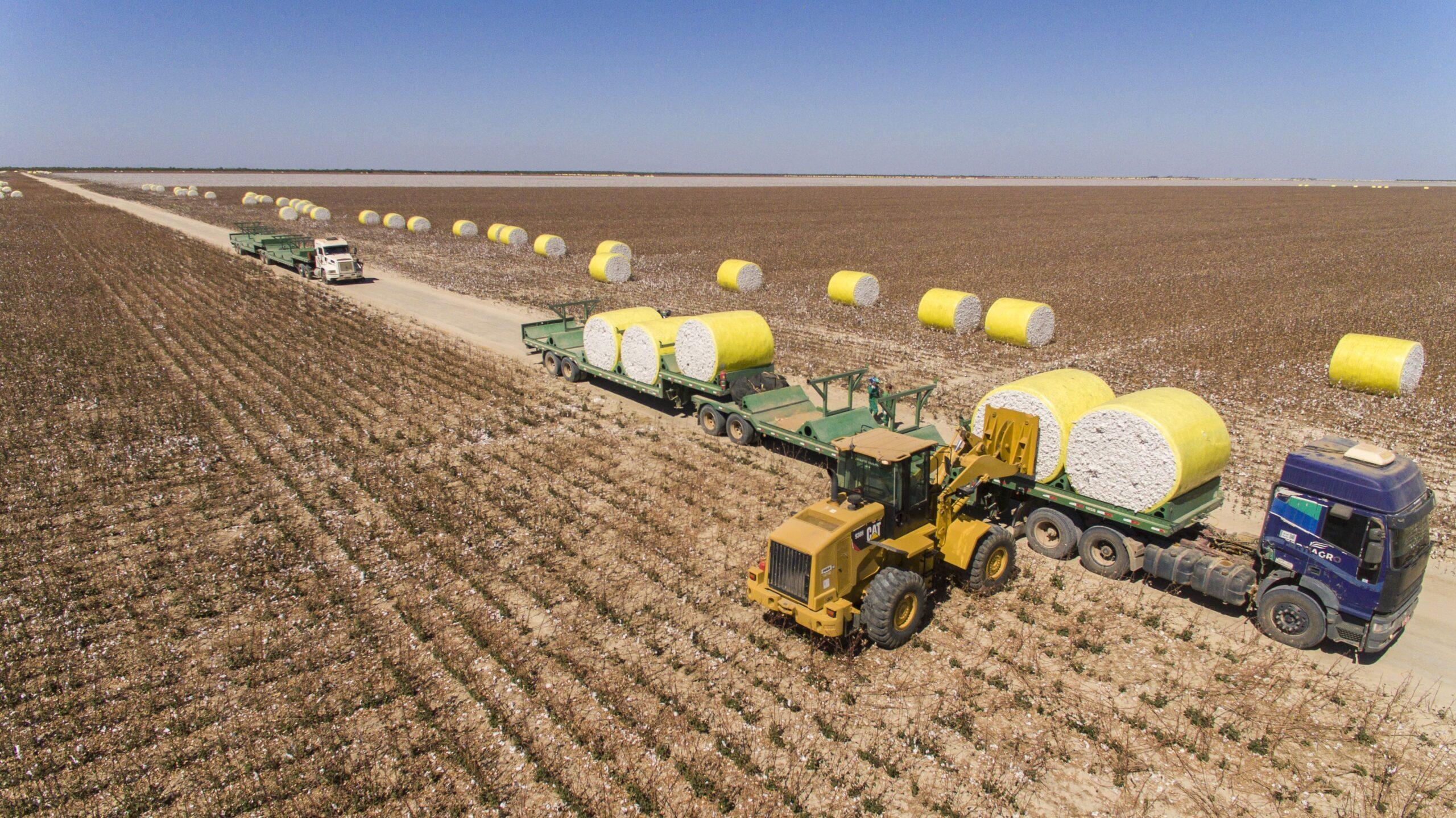
Brazil closed the 2025/26 commercial year as the world's leading cotton exporter, shipping a record 3.37 million tonnes between August 2025 and July 2026. The volume was 19% above the previous cycle and more than double the 1.45 million tonnes shipped four years earlier, according to Notícias Agrícolas, which reported on the debate at the Brazilian Cotton Congress in Belo Horizonte.
The result opens a new question for the supply chain at the moment the sector is working with the possibility of expanding planted area again in 2026/27: after taking share from competitors, where does the next increment of Brazilian export growth come from? The answers discussed at the congress run along several fronts — new markets, more global demand for the fibre, and higher value captured per tonne shipped through quality, traceability and closer relationships with mills.
From seasonal supplier to twelve-month shipper
André Pessoa, chief executive of Agroconsult, said one of the advantages Brazil built was ceasing to be a supplier concentrated in specific periods and becoming one that puts relevant volumes on the international market in practically every month of the year. While the United States and Australia still show more pronounced seasonality in their exports, Brazilian supply gained consistency as production and logistics capacity grew, allowing the country to occupy the main consuming markets.
For Aurélio Pavinato, president of SLC Agrícola, the shift has already moved beyond a cyclical condition. He links Brazil's position to productivity gains, the ability to grow two crops in the same year, the efficiency of the production system and continuous availability. “The change is structural. Brazil is winning the international market as a consequence of our high productive efficiency and our production system. The ability to run two crops and have high productivity is what guarantees this competitiveness and the possibility of offering cotton 12 months a year. The customer wants security of constant supply,” Pavinato said. In his reading, world production and consumption have advanced little over roughly two decades while Brazil sharply expanded output and took share previously held by other suppliers.
China leads destinations, India multiplies
China bought 770,500 tonnes in the 2025/26 commercial year, roughly 23% of everything Brazil exported in the period. Beyond that concentration in a single large buyer, the chain's strategy has been to diversify across different textile industries in Asia and other markets. India illustrates how fast a destination can gain weight: the country took more than 350,000 tonnes of Brazilian cotton in 2025/26, more than 40 times the volume recorded two years earlier. Data released by Abrapa indicate Brazil now accounts for about 40% of Indian imports of the fibre, even though India ranks among the world's largest cotton producers.
Abrapa president Gustavo Piccoli cited India as evidence that there is still room to widen the Brazilian presence, arguing that export growth and destination diversification give the chain confidence to work with a possible production increase in coming cycles, provided the country preserves productivity, competitive costs and quality. Market opening is a complementary front. At the congress, Agriculture and Livestock Minister André de Paula highlighted government work to widen access for Brazilian products and cited Egypt, a market opened to Brazilian lint in 2023; the ministry has pointed to the quality and competitive prices of Brazilian cotton and its potential to win share in a market traditionally supplied by Greece and Sudan.
Washington defends its share
Winning new buyers is not happening against passive competition. Pessoa drew attention to the United States' reaction to its loss of international market share, saying American trade policy has become part of the dispute, including through negotiations on textile access to the US market associated with a preference for the use of American cotton. Brazil, in his assessment, will have to defend its position while trying to expand it.
The effort matters more because additional Brazilian output has to find an outlet mainly abroad. Francisco Queiroz, an analyst at Itaú BBA, noted that domestic consumption has not advanced at the same pace as productive capacity, making exports essential to absorb the surplus. The bank expects China, Vietnam, Bangladesh and India to continue playing a relevant role in diversifying Brazilian sales.
The polyester question
For 2026/27, the United States Department of Agriculture projects some recovery in demand. World mill consumption is estimated at 122.9 million bales, up 1.5% on the previous cycle and the highest level in six years, while global production is projected at 117.3 million bales. The gap points to a season in which consumption tends to exceed output, but it does not settle the structural discussion about lifting cotton use more consistently over the long term.
That is where the competition changes scale. Instead of seeing only the United States, Australia or other exporters as commercial adversaries, participants in the congress roundtable placed synthetic fibres, particularly polyester, as a dispute common to all cotton growers. “The big message is that we need to increase cotton's share relative to synthetics, regardless of origin,” said Alexandre de Marco, vice-president of Abrapa and a director of CCAB Agro. Pavinato followed the same line, arguing that on this front producing countries stop being competitors with each other and face polyester as their main rival.