Brazil’s BRS Áurea pear raises questions for Argentine suppliers
Embrapa’s BRS Áurea pear combines potential yields of 25-30 tonnes per hectare with an early January harvest and adaptation to southern Brazil. Commercial adoption remains unproven, but expanded local production could gradually increase competition for Argentine pears in their principal export market.
A variety designed for southern Brazil
Brazil’s development of the BRS Áurea pear has introduced a new long-term consideration for fruit growers and exporters in Argentina’s Alto Valle. The variety, created by the Brazilian Agricultural Research Corporation, Embrapa, promises strong productivity, an early harvest and adaptation to climatic conditions in southern Brazil. According to LM Neuquén, it is not yet a concrete commercial threat, but it could support efforts to reduce Brazil’s dependence on imported pears.
Embrapa crossed the Asian Hosui pear with the European Abate Fetel variety in Vacaria, Rio Grande do Sul, in 2006. After almost two decades of selection, agronomic assessment and validation in different production environments, BRS Áurea was entered in Brazil’s National Cultivar Registry in May 2025.
The variety is recommended for regions receiving between 400 and 600 hours of winter temperatures below 7.2°C. That requirement corresponds to certain fruit-producing areas in southern Brazil and gives growers locally adapted genetic material for a crop that has not developed significant domestic production.
Early harvest and storage potential
In evaluated areas of Rio Grande do Sul, BRS Áurea recorded potential yields of 25-30 tonnes per hectare. Its harvest is concentrated mainly between January 5 and 20, while the cycle from full flowering to maturity is approximately 106 days. The timing could allow Brazilian fruit to reach the market earlier and extend the domestic selling season.
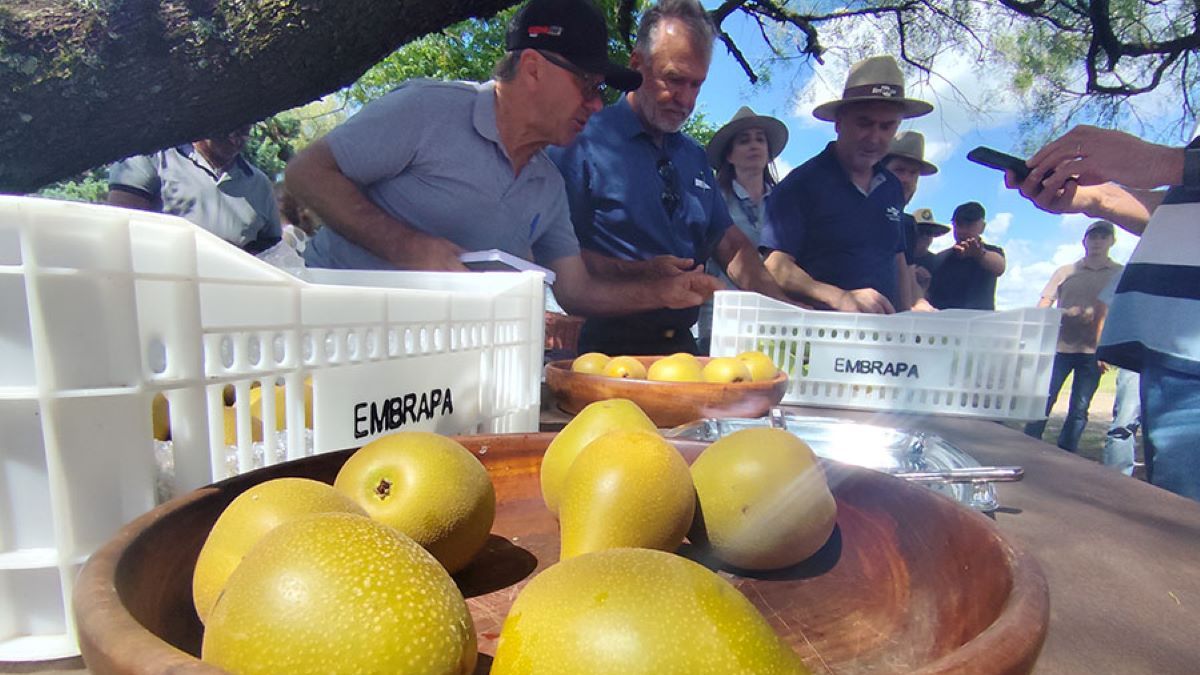
The pears are uniform, medium to large and weigh 145-190 grams. Their skin changes from orange-yellow to golden as they mature, while the flesh is white, crisp and juicy. Tests also found resistance to entomosporium leaf spot and lower susceptibility to fruit fly than the Rocha pear, an imported variety sold in Brazil.
Post-harvest performance could help determine whether the cultivar moves beyond experimental plantings. Fruit retained good eating quality after 90 days of refrigerated storage at 0.5°C followed by seven days at 20°C. Under controlled-atmosphere conditions, pears stored for up to 165 days at 0.5°C maintained greater firmness after removal from storage.
Argentina faces a long-term competitive test
Brazil still depends on pear imports, and LM Neuquén describes domestic production as effectively nonexistent. The country is also the principal destination for pears from the Alto Valle of Río Negro and Neuquén. Any sustained increase in Brazilian output could therefore reduce import requirements, put pressure on prices during parts of the season and raise expectations for quality, condition and continuity of supply.
The commercial effect remains uncertain. Trial yields do not establish how the variety will perform across large orchards, and its future depends on planted area, results outside experimental conditions, consumer acceptance and the ability of Embrapa and private growers to accelerate orchard development. Brazil’s large domestic demand means imported fruit will remain necessary for now.
For Argentine suppliers, the relevant precedent is Brazil’s apple industry. During the 1980s, expanding Brazilian production progressively displaced imports, including fruit from Argentina. BRS Áurea does not indicate that the same outcome is imminent for pears, but it gives the Alto Valle an incentive to strengthen productivity, plant health, storage, logistics and commercial differentiation while developing additional destinations. The competitive implications will become clearer only when commercial acreage and orchard yields can be measured.