BL Agro commits ₹15 billion to integrated dairy genetics project in India
BL Agro has announced a ₹15 billion investment in biotechnology subsidiary Leads Genetics to connect cattle breeding, animal health, nutrition, milk production, processing and marketing. The company targets monthly production of 15,000 embryos by the end of 2027 and estimates that genetically selected cows could yield 40–60 litres of milk per day.
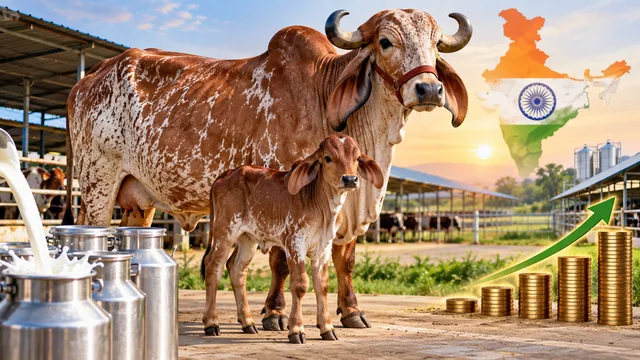
Investment spans the dairy value chain
BL Agro has announced an investment of ₹15 billion, equivalent to ₹1,500 crore, in its biotechnology subsidiary Leads Genetics as it seeks to build an integrated dairy and cattle-genetics ecosystem in India. According to Dainik Jagran, the initiative is intended to connect genetics, breeding, animal health, nutrition, milk production, processing and marketing.
The project places reproductive technology at the centre of the production model. Leads Genetics plans to create embryos selected for higher milk output and implant them in cows through a process comparable to in vitro fertilisation. Female calves born through the programme would subsequently enter dairy herds as higher-yielding cows.
BL Agro chairman Dr Ghanshyam Khandelwal said farmers would be at the centre of the company’s circular-economy model. The company expects improved genetics to raise milk output and reproductive performance while creating additional income opportunities for farmers. These outcomes, however, will depend on the performance of the animals outside controlled breeding facilities and on access to suitable nutrition, veterinary care and farm management.
Elite Gir calf marks breeding milestone
India’s first genetically selected elite Gir calf was born during a cattle genomics summit at BL Kamdhenu Farms in Bareilly, Dainik Jagran reported. The development was presented as a milestone in animal-genetics cooperation between India and Brazil. Gir cattle are an indigenous Indian breed, making the programme relevant both to productivity improvement and to efforts to conserve and develop domestic genetic resources.
SK Agarwal, director of BL Kamdhenu Farms, said genetically selected cows could produce high-quality milk, with average output estimated at 40–60 litres per cow per day. That figure is a company estimate rather than reported commercial-farm performance. Reaching it consistently would represent a substantial production gain, but genetics alone cannot determine realised yields.
The company also plans domestic production of elite bulls, embryos and sexed semen. BL Agro says this could reduce India’s dependence on imported breeding material while strengthening indigenous breeds. A genomic chip demonstrated at the summit will assess animal DNA using thousands of genetic markers and support the company’s certification process.
Embryo capacity and regional expansion
Leads Genetics co-founder Dr Ashish Dubey said the company’s Centre of Excellence in the Bareilly district aims to produce 15,000 embryos per month by the end of 2027. Achieving that scale would move the project beyond selective herd improvement toward industrial production of breeding material. It would also require a network capable of embryo transfer, pregnancy monitoring, animal-health support and reliable performance recording across participating farms.
BL Agro is discussing the development of integrated dairy and genetics ecosystems in Uttar Pradesh, Maharashtra, Bihar and Madhya Pradesh. Expansion across four major agricultural states would widen the potential market for embryos, sexed semen and related services, while testing whether the model can work under different climatic and farming conditions.
At the summit, Madhya Pradesh Deputy Chief Minister Rajendra Shukla said modern genetics, breeding technology and scientific research could strengthen the dairy and livestock sector. Cabinet minister Dharampal Singh noted that India is the world’s largest milk producer but still needs to raise productivity per animal. For dairy farmers and processors, the commercial significance of the investment will therefore rest on whether the breeding programme converts its laboratory targets into repeatable farm-level milk gains.