Belgium's 2026 cereal harvest is the earliest on record, with lower yields but strong quality
The Belgian Grain Trade Federation (Fegra) reports that successive heat waves pushed the 2026 straw cereals harvest to the earliest completion ever recorded in Belgium. Feed wheat yields fell 6 to 14% from an exceptional 2025, while protein was high, moisture low and wheat specific weight averaged close to 79 kg/hl.
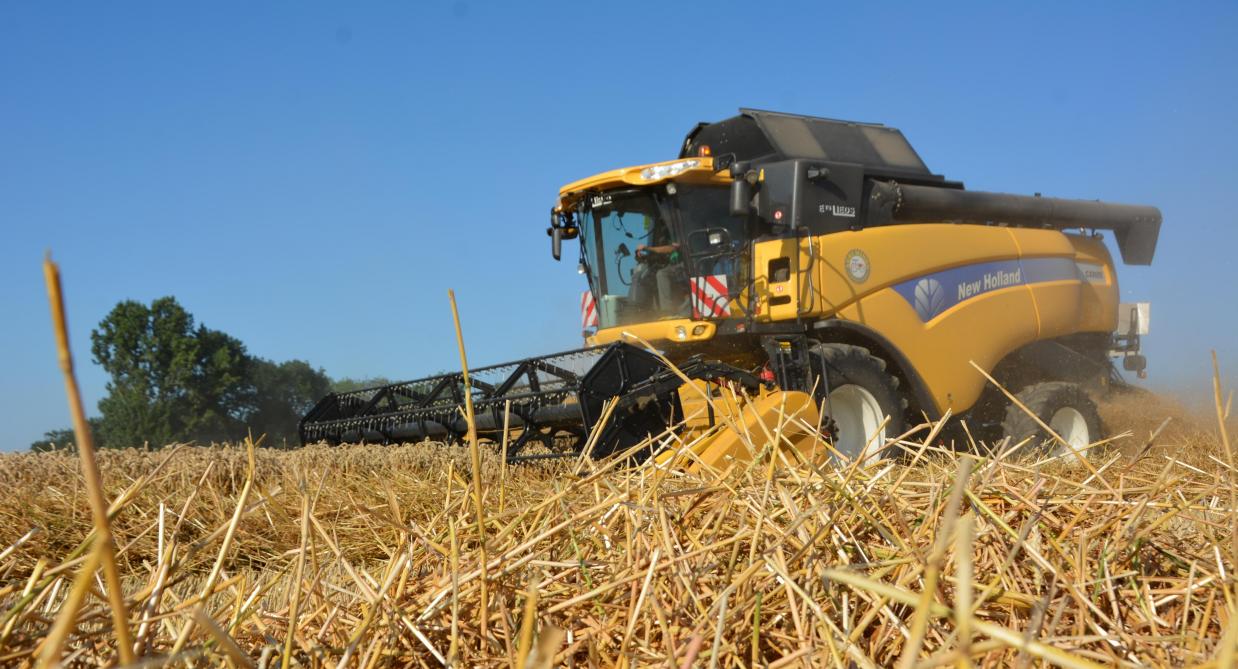
Harvest completed at a record pace
The Belgian Grain Trade Federation (Fegra) has published its quantitative and qualitative assessment of the 2026 Belgian straw cereals harvest, excluding maize. The review is based on provisional area declarations from the Walloon and Flemish regions and on a detailed survey of Fegra members, and was reported by the agricultural outlet Sillon Belge.
Successive heat waves pushed the harvest forward at a record pace. By mid-July, most winter cereals in Flanders had already been cut, which is exceptionally early by Belgian standards. According to Fegra, cereals have never been harvested this early in the country: winter barley was in store two weeks ahead of wheat, which then followed at an equally rapid pace. By comparison, around 80% of the area had been harvested by 21 July last year. In the south-east of the country, cutting continued into early August.
Yields retreat from an exceptional 2025
Feed wheat yields fell 6 to 14% against 2025. Winter barley was down 5 to 11%. Triticale held up relatively well, at -9% in Wallonia and -2.5% in Flanders, while spring barley and oats recorded the sharpest declines, exceeding 25% in the south of the country. Spelt came in 7 to 9% below 2025, although yields remain at a reasonable level, Fegra said.
The late-June heat wave disrupted wheat maturation and cut yield potential by roughly 1 tonne per hectare. The impact stayed largely confined to yield: dry weather held after the storms and through the harvest, so even lodged plots were cut with relatively few losses. Most yields remain in line with the multi-year average or slightly above it, and it is mainly the unusually strong 2025 reference year that makes this season's declines look severe.
The rapeseed crop came in slightly below 2025, with yields between 4.4 and 4.7 t/ha depending on the region, against 4.5 to 5.5 t/ha a year earlier. That still corresponds to an average to good year.
Quality holds up and drying costs fall to almost nothing
The dry, sunny season supported high protein content and low moisture. Despite the heat, specific weight averaged above 76 kg/hl across cereals. Wheat averaged close to 79 kg/hl this season, after 78.45 kg/hl in 2025. Fegra reported the following averages for the other crops:
- Spring wheat: 75.3 kg/hl
- Winter barley: 65 kg/hl
- Triticale: 74.5 kg/hl
- Spelt: 37.6 kg/hl
- Oats: 47.3 kg/hl
Moisture content was 5 to 17% below 2025 across almost the whole range, at around 12.3% on average for winter barley against 13 to 13.4% last year, so the use of drying was close to nil. The counterpart is wider variation. Some plots were cut at very low moisture before wheat had completed physiological maturity, which weighed on specific weight, and wheat lodged by earlier storms also returned low values. Values therefore vary strongly this year, Fegra noted.
Global picture: Western Europe down, Black Sea and Canada up
World wheat production is estimated at 819.3 million tonnes this year, down from 843.35 million tonnes, while consumption of 826.27 million tonnes exceeds supply. EU-27 output is put at 134.2 million tonnes against 138.3 million tonnes last year, although the average yield of 5.66 t/ha remains above the five-year average of 5.63 t/ha, which Fegra describes as a good year at European level. Barley is seen 3.38 million tonnes higher at 157.07 million tonnes, from 153.69 million tonnes, and world ending stocks of 22.13 million tonnes lift the stocks-to-use ratio from 12.40% to 14.20%.
Combined wheat and barley production reaches 976.4 million tonnes, down more than 2.15% from the previous campaign. Fegra attributes almost the entire decline to Western Europe, where an exceptionally hot and dry end of June and July forced maturation too quickly. The EU-27 loses ground in both crops, with France particularly affected alongside the United Kingdom. Ukraine, Russia, Kazakhstan and Canada all post net gains in both crops, with the Canadian growing season running particularly favourably according to the vegetation index.
Geopolitics is adding to market pressure. Intensified attacks on Ukrainian port and maritime infrastructure have almost entirely paralysed seaborne grain exports, through loading interruptions and reluctance among insurers. Alternative land and Danube routes are either saturated or targeted themselves, while Hungary, Poland and Slovakia maintain their import bans. Escalation in the Black Sea and downward revisions to world production are driving a clear upward trend across the grain market. Fegra sees no risk of a global shortage, but says logistics and geopolitics continue to underpin price volatility.