Battery-Electric Cars Reached 17.3% of EU New Registrations in 2025 as Germany Led on Volume
Around 1.89 million battery-electric passenger cars were newly registered in the European Union in 2025, close to 30 percent more than a year earlier and 17.3 percent of the total market. Germany was the largest single market with roughly 545,100 units, while Denmark led on share at 67.8 percent. Charging capacity in Europe is expected to double by 2030.
Some 1.89 million battery-electric passenger cars were newly registered in the European Union in 2025, an increase of just under 30 percent on the previous year, according to the German Federal Statistical Office (Destatis) citing Eurostat data. That took the battery-electric share of all new registrations to 17.3 percent, compared with 0.4 percent in 2015, heise.de reported.
The Eurostat series counts only cars powered exclusively by a battery; plug-in hybrids and conventional full and mild hybrids are recorded as separate categories. The European manufacturers association ACEA puts the battery-electric share marginally higher, at 17.4 percent. The gap reflects different data sources, definitions and rounding: Eurostat evaluates harmonised reports from national statistical offices, while ACEA relies on national industry associations and S&P Global Mobility, and parts of its annual data remain provisional.
ACEA counted around 10.8 million new passenger cars registered in the EU last year, 1.8 percent more than in 2024. Hybrids without an external charging option formed the largest group at 42.4 percent, ahead of pure petrol cars at 27.3 percent. Diesel accounted for only 9.8 percent.
A bloc split by charging points and subsidies
National shares diverge sharply across the member states:
- Denmark: 67.8 percent
- Netherlands: 40.2 percent
- Malta: 37.6 percent
- Bulgaria: 4.9 percent
- Slovakia: 4.7 percent
- Croatia: 1.9 percent
Destatis names the build-out of charging infrastructure and national support policy as the main factors behind the spread. Outside the EU, Norway reached 95.1 percent.
Germany leads on volume, France follows
Germany registered around 545,100 new battery-electric cars, a 19.1 percent share and slightly above the EU average. In absolute terms it was the largest single market in the bloc, accounting for almost 29 percent of all battery-electric cars registered in the EU. Registrations rose by a good 43 percent against 2024. France followed with roughly 330,900 units.
The German increase is flattered by the comparison base. The market slumped in 2024 after the abrupt end of the Umweltbonus purchase incentive in December 2023, when the battery-electric share fell from 18.4 percent to 13.5 percent. The 2025 recovery was carried mainly by fleets and commercial owners rather than private buyers.
heise.de lists high fuel costs, falling vehicle prices, a wider model range, stricter CO2 fleet targets and cheap Chinese cars as the main drivers. Chinese brand BYD increased its EU-wide registrations by more than 227 percent in 2025, while US manufacturer Tesla fell by close to 38 percent.
Charging network and grid load
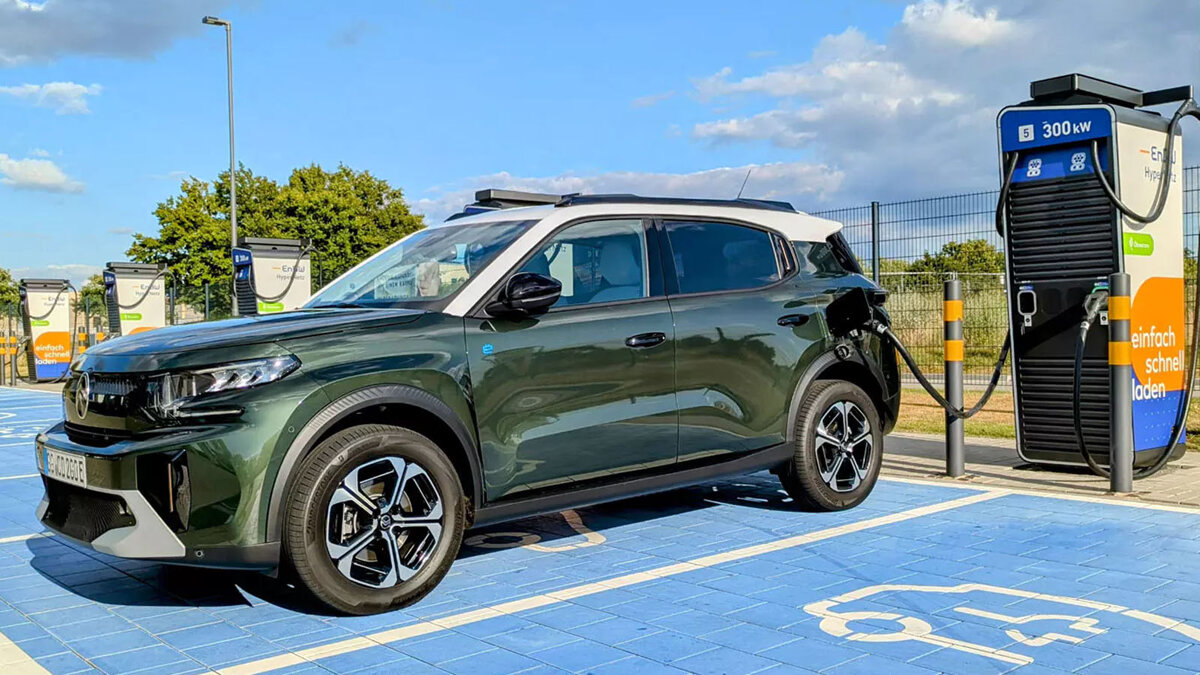
A rising electric share requires a matching build-out of charging capacity. At the end of 2024 slightly more than one million public charging points were in operation in Europe, over 163,000 of them in Germany. In its base scenario the International Energy Agency expects a doubling to more than two million charging points in Europe by 2030, with fast chargers making up around 30 percent of the total.
Electric vehicles have so far accounted for about one percent of European electricity demand; the IEA sees that share rising above four percent by 2030. The central challenge lies less in annual energy volumes than in peak loads, for example from uncontrolled charging in the early evening. Controlled and, in time, bidirectional charging can ease that pressure considerably, according to the Fraunhofer Institute.
Further growth is expected in Germany this year, as payments under the current electric car subsidy are being made retroactively from 1 January. A recent study on willingness to switch found that 27 percent of combustion-engine owners in Germany plan to move to an electric car, a higher share than in the United Kingdom or France.