Bangladesh Leads South Asia on Rice Yields but Sits Near the Global Average
Bangladesh produced about 5.3 tonnes of paddy per hectare in 2024, the highest in South Asia but close to the world average of 4.7-4.8 tonnes. With 41.9 million tonnes produced in FY25 and a record import bill of $682.4 million after flood losses, analysts say the binding constraint is technology adoption and farm management rather than a lack of improved varieties.
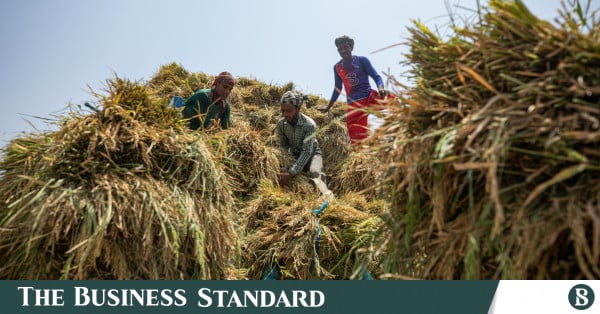
Bangladesh recorded the highest rice productivity in South Asia in 2024, at about 5.3 tonnes of paddy per hectare, ahead of India at roughly 4.3 tonnes, Nepal at 4.19 tonnes and Pakistan at 3.74 tonnes, according to Food and Agriculture Organization data cited by The Business Standard. Measured against global benchmarks, the same figure places the country in the middle of the field.
The world average is roughly 4.7 to 4.8 tonnes per hectare. China reaches about 7.1 tonnes, the United States 8.68 tonnes and Australia 11.9 tonnes. Egypt, a semi-desert producer, achieves yields approaching 9.1 tonnes per hectare. The distance between the regional lead and the global frontier is what turns a productivity statistic into a supply question.
Flood losses drive a record import bill
Bangladesh produced around 41.9 million tonnes of rice in FY25, according to the Department of Agriculture Extension, yet still imported 1.436 million tonnes, the highest volume in seven years. In value terms the shift was far sharper: rice imports rose from $25.4 million in FY24 to $682.4 million in FY25, an increase of 2,584%, after floods damaged more than 1 million tonnes of domestic rice.
The resource base carrying that output is also under strain. The groundwater-intensive boro system is putting growing pressure on water resources, particularly in the drought-prone northwest, which limits how far additional irrigation can lift national output. With yield growth slowing and climate shocks exposing the limits of domestic supply, imports are functioning as a buffer rather than a marginal top-up.
Technology reaches the lab, not the field
Sayla Khandoker, assistant professor at the Department of Agricultural Economics at Sher-e-Bangla Agricultural University, said productivity depends on genetic potential, input use covering seed, fertiliser, labour and irrigation, technology adoption, soil quality, climatic risk and socioeconomic factors such as farming experience, education and extension contact. Bangladesh's difficulty, she said, is converting available technology into profitable and reliable adoption at scale.
The Bangladesh Rice Research Institute has developed around 127 high-yielding modern rice varieties, including salt-tolerant, drought-tolerant and short-duration types. “But how many of them are actually in farmers' fields? That is the main concern,” Khandoker said, identifying weak linkages among research, extension and farmers as the binding constraint. Research cited in the report found that farmers adopting hybrid rice varieties were 6.24% more technically efficient and recorded 12.03% higher frontier-predicted yields than non-adopters.
Management weighs more than genetics
Jahangir Alam Khan, agri-economist and former member-director of the Bangladesh Agricultural Research Council, attributed the ceiling to a mix of technological and management constraints. Farm-management practices are less efficient than in China or the United States, he said, and fertiliser and water are not always applied at optimum levels, with over-application in some cases and under-application in others. Soil quality is affected as a result, and restoration steps are not consistently taken.
The research base is nonetheless substantial. Khan put BRRI's output at around 120 varieties, with universities and institutions including the Bangladesh Institute of Nuclear Agriculture accounting for roughly 150 in total. A BRRI study titled “Doubling Rice Productivity in Bangladesh” found that improved management could reduce the genetic gain required to reach long-term productivity targets by about 41%, and farm-level research has identified management as a larger contributor to yield variation than genetics.
Three routes taken elsewhere
The comparators cited in the report followed distinct paths to higher output:
- China pushed the genetic frontier through decades of state-backed hybrid-rice research, cutting rice-growing acreage by about 14% after 1978 while raising production by more than 44%; its super-hybrid programme has targeted around 12 tonnes per hectare, with experimental varieties exceeding 17 tonnes.
- Vietnam focused on management in response to ecological pressure in the Mekong Delta, including alternate wetting and drying instead of permanent submergence, alongside its One Million Hectares of High-Quality Rice programme.
- The United States and Australia relied on capital-intensive precision agriculture, with mechanised land preparation, precision fertiliser application, controlled irrigation and farm monitoring.
Owen Calvert, Chief of Party and Team Lead in Bangladesh for the International Maize and Wheat Improvement Center (CIMMYT), framed the next phase as efficiency rather than expansion, saying productivity must rise while land, labour, water and fertiliser are used more sustainably. With support from the United States government, CIMMYT is developing technology for more precise fertiliser placement in rice production, and Calvert said mechanised transplanting can address labour shortages and enable more timely crop establishment.