Bangladesh fruit prices surge as import taxes and dengue demand squeeze consumers
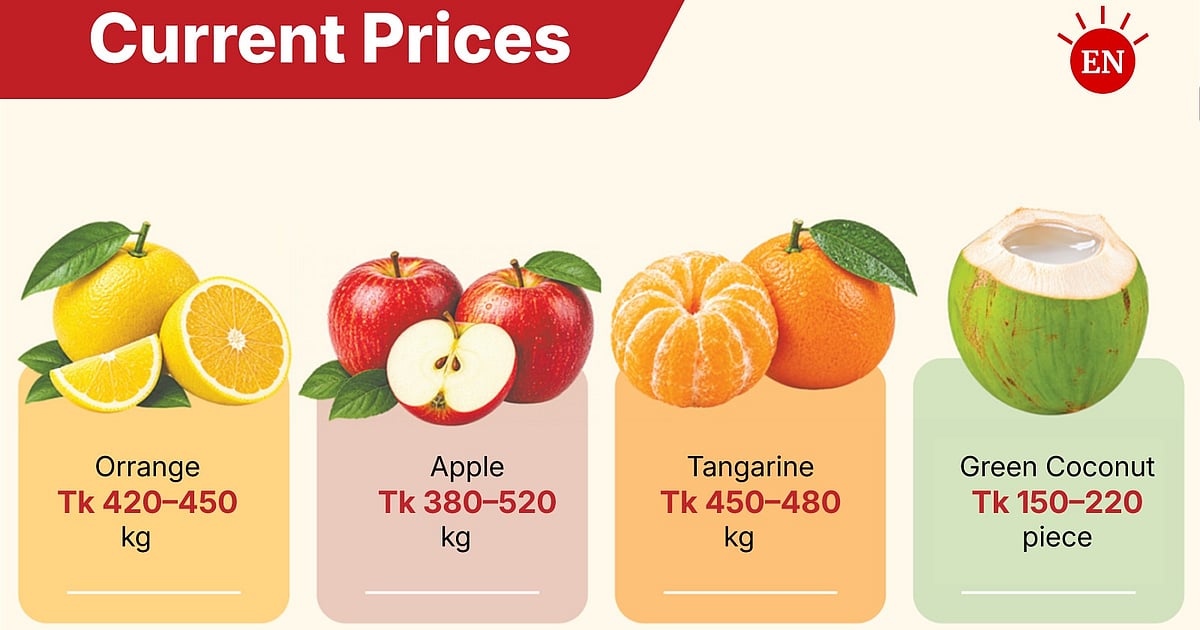
Orange prices in Dhaka have reached Tk 450 per kg, or roughly Tk 100 for a large fruit, while green coconuts sell for Tk 150–220 each. Prothom Alo links the increases to a 122% tax burden on imported fruit, a weaker taka and stronger demand during the dengue outbreak.
Oranges reach Tk 450 per kilogram
Fruit prices in Bangladesh have risen sharply, placing both imported and locally grown products under pressure and reducing affordability for consumers. At a roadside stall on Dhanmondi’s Road 15 in Dhaka, oranges were offered at Tk 450 per kilogram, Prothom Alo reported. Five slightly larger oranges weighed just over one kilogram, putting the price of each fruit at about Tk 100. Traders said imported fruit sold for around Tk 150 per kilogram in the capital before 2022.
Other imported products are also expensive. Tangerines are selling for Tk 450–480 per kilogram, while pomegranates cost Tk 450–650 depending on size and quality. Apples are priced at Tk 380–520 per kilogram and grapes at Tk 480–550. Domestic alternatives offer limited relief: good-quality ripe papaya costs around Tk 120 per kilogram, and a medium-sized fruit sells for more than Tk 150. Guava, pomelo, hog plum and locally grown green oranges are also available, but local fruit is not considered inexpensive.
Taxes and currency add to import costs
The current duties and taxes on imported fruit total 122%. For every Tk 100 worth of fruit brought into Bangladesh, importers therefore pay Tk 122 in duties and taxes. The exchange rate has added another cost layer: the dollar was worth Tk 86 in 2022 and now stands at Tk 123. The two factors have substantially raised the local-currency cost of imported produce.
The additional taxes were introduced in 2022 as Bangladesh faced a dollar shortage and sought to restrict imports. Economist and former Bangladesh Bank governor Ahsan H Mansur told Prothom Alo that the need for import-control measures had ended during his tenure. He said the decision to reduce duties and taxes rests with the National Board of Revenue and described the 122% burden as unacceptable.
Bangladesh Bank withdrew the requirement for fruit importers to deposit 100% of the value of letters of credit as a margin last month. Import volumes have also increased. National Board of Revenue data show that Bangladesh imported 23,717 tonnes of oranges, apples, tangerines and grapes in July and 41,186 tonnes in August. Another 23,536 tonnes of fruit entered the country during the first 19 days of September. The continued high retail prices despite these volumes point to taxes, exchange costs and distribution margins as important constraints beyond the availability of imports alone.
Dengue increases demand for juice and coconut water
Traders attribute the latest price increases partly to stronger demand during the dengue outbreak. So far this year, 61,972 dengue patients have been admitted to hospitals and 184 people have died. Dengue specialist Professor Robed Amin told Prothom Alo that heavy sweating during the early stages of the illness causes patients to lose substantial amounts of fluid and salt. Patients are therefore advised to consume oral saline, fruit juice, green coconut water and soup.
Green coconuts are now selling at roadside stalls and markets in Dhaka for Tk 150, Tk 180 or Tk 220 each, depending on size. The increases make products commonly bought for patients harder to afford just as health-related demand strengthens. Bangladesh Bureau of Statistics surveys put average daily per-capita fruit consumption at 45 grams in 2010, 36 grams in 2016 and 95.4 grams in 2022, although questions have been raised about the data. No figures are available to show whether consumption has fallen since 2022 as prices increased.