Austrian sawmill chip prices top €200 per tonne as pellet costs rise about 30%
Prices for sawmill wood chips in Austria have moved from around €115–135 per tonne atro ex sawmill at the end of 2025 to asking prices above €200, according to market data cited by biorefinery AustroCel Hallein. With 320,000 tonnes atro consumed a year, every €10 per tonne adds €3.2 million to the company's costs. The Salzburg Chamber of Labour reports pellet prices up about 30% year on year.
Chip prices up more than 50% in under a year
Prices for sawmill wood chips in Austria have risen steeply since the second half of 2025. Market reports quoted by AustroCel Hallein showed levels of around €115 to €135 per tonne of oven-dry material (atro) ex sawmill at the end of 2025. By the second quarter of 2026, prices of up to €155 per tonne atro ex sawmill were being reported. Current market information from AustroCel points to asking prices above €200 per tonne atro (BDMT) ex sawmill. The company cites Holzkurier market reports from November 2025 and April/May 2026 alongside its own current market data.
Sawmill chips and other sawmill by-products have been core feedstock for pulp, paper and wood-based panels for decades. AustroCel argues that the price move shows how competition for a limited wood supply is intensifying, with several material and energy applications drawing on the same volumes at the same time.
Every €10 per tonne costs the plant €3.2 million
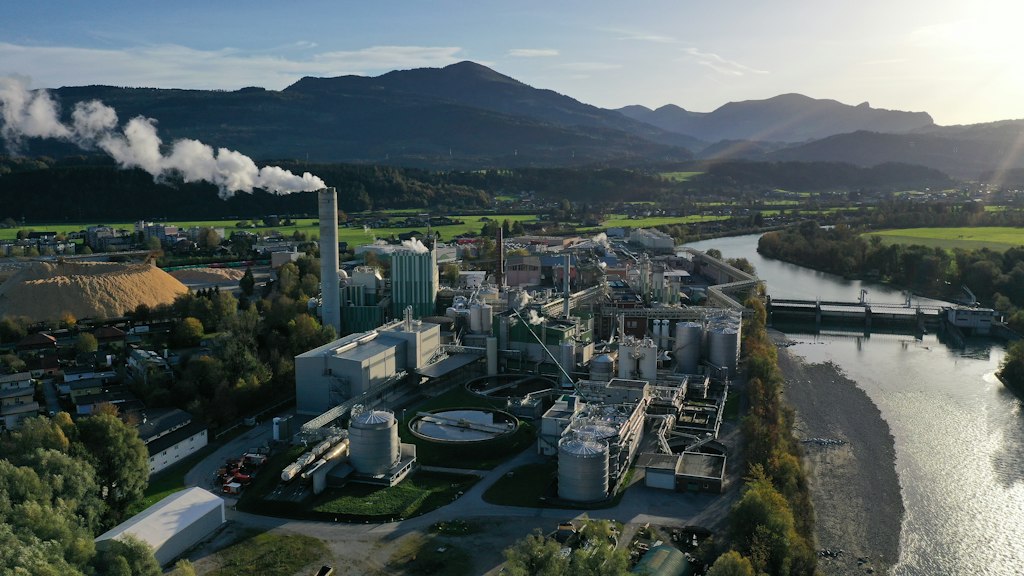
AustroCel processes around 320,000 tonnes atro of wood a year at its Hallein site. On that volume, every permanent increase of €10 per tonne in the average wood price adds roughly €3.2 million in annual costs. An increase of €50 per tonne works out at €16 million a year if the full wood volume is affected. For comparison, the company reported revenue of €155 million in 2025, employs 347 people and has capacity of up to 160,000 tonnes of cellulose per year.
„We sell our products on international markets. We cannot simply pass regionally sharp increases in raw material costs on to our customers“, said AustroCel managing director Wolfram Kalt. „If central European wood prices decouple permanently from the international competitive level, a raw material question becomes a question about the site.“
The Hallein plant produces viscose pulp, bioethanol and biogas, as well as electricity and district heating for its own use and for the region. It also makes cellulose products for non-textile industrial applications, including pharmaceuticals, food and construction, and started pilot operation of a hydrogel granulate for soil water retention in July 2025. AustroCel can supply up to 30,000 households with electricity and/or district heating, and its bioethanol capacity is equivalent to almost 1% of Austrian petrol demand. The company has been part of Japan's Oji Group since January 2026.
Heating pellets add a consumer dimension
The same scarcity is reaching households through heating pellets, whose prices have been climbing steadily for weeks with no end to the trend in sight. The Salzburg Chamber of Labour has raised the roughly 30% increase in pellet prices against the previous year and is calling for the price development to be reviewed, for political measures and for a price cap. AustroCel does not assess those claims but sees in them a further reason for maximum transparency on raw material flows, price formation and the effect of public subsidies.
Allocation rules move to the centre
The question is gaining weight at European level as well. A draft impact assessment for the post-2030 European renewable energy framework, known as RED IV and made public in early September, points to the limited availability of forest biomass and to partly suboptimal allocation of scarce biomass resources. The draft also addresses possible false incentives for low-value energy use of high-grade raw materials. AustroCel sets out three principles.
- Wood that can be put to high-value material use should be used materially first.
- Sawmill by-products should not be treated as a preferred energy feedstock simply because they are classified as secondary biomass or residues; their actual suitability for material use is what counts.
- Subsidies and regulatory simplifications should mobilise genuinely additional, so far unused biomass rather than pull raw material out of existing industrial value chains.
AustroCel warns against turning the issue into a conflict between industry and bioenergy, describing bioenergy as an important part of a renewable energy system and calling for material use first and energy at the end of the cascade. Austria wants to strengthen timber construction, the bioeconomy, pulp and paper, renewable heat and security of supply at the same time, but all of these draw on the same limited raw material base. „We must not plan the same tonne of wood several times over in political terms. Austria does not need a debate of industry against energy, but transparency about the available volumes and intelligent allocation of its limited wood resources“, Kalt said.