Australia Suspends Vietnamese Pomelo Imports on Biosecurity Grounds Months After Granting Access
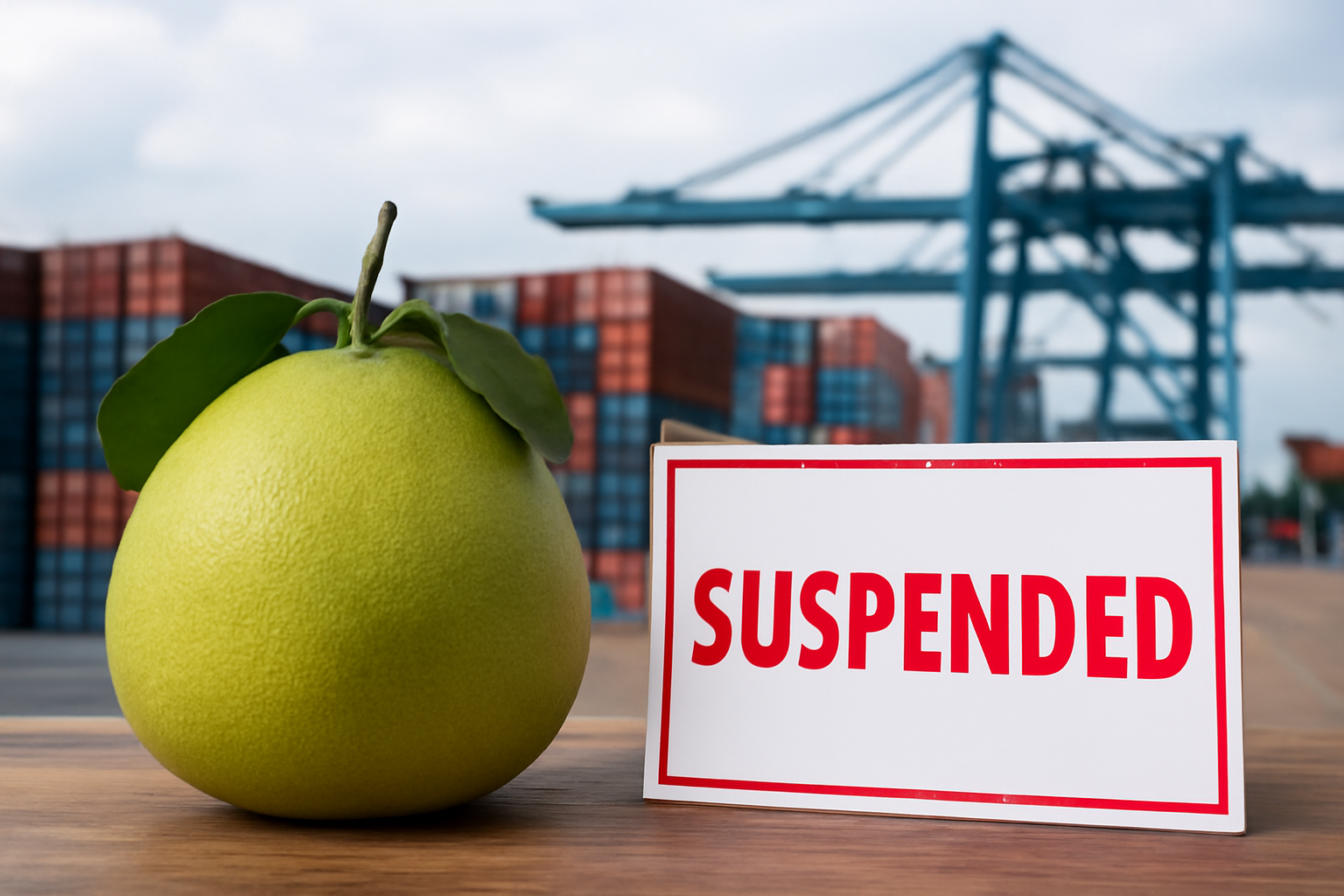
Australia has suspended imports of Vietnamese pomelo over biosecurity concerns, only months after the fruit was first granted access to the Australian market. The specific pest or compliance failure behind the decision has not been disclosed in available reporting. The immediate volume loss is small, but the suspension hits growers, packhouses and exporters that invested to meet the new protocol.
Access granted, then paused
Australia has suspended imports of Vietnamese pomelo, citing biosecurity concerns. The suspension comes only months after Vietnamese pomelo was first granted access to the Australian market, closing — at least temporarily — a trade lane that took years of technical negotiation to open.
The specific organism behind the decision, the number of consignments involved and the volumes affected have not been disclosed in the reporting available so far. What is established is the sequence: access granted, first commercial shipments, then a suspension on biosecurity grounds before the trade had time to build a track record.
Why a newly opened market can close this fast
Australia runs one of the strictest plant-health regimes among developed import markets, and access for a new fruit from a new origin is never a tariff question. It follows an import risk analysis that identifies the quarantine pests of concern and fixes the conditions under which trade may proceed: registration of orchards and packhouses, in-field pest control, pre-export inspection, usually a phytosanitary treatment, and certification by the exporting country's plant protection authority. Every consignment arrives against that agreed protocol.
The corollary is that the protocol is also the failure point. If border inspection detects an organism the system was designed to exclude, the standard regulatory response is to stop trade while the cause is established, rather than to tighten inspection at the margin. Suspensions of this kind are rarely permanent. They typically end when the exporting authority traces the breakdown to a specific orchard, packhouse or treatment facility, removes it from the approved register and agrees to strengthened conditions. The timing, however, is controlled by the importing regulator, and reinstatement can take weeks or overrun a full harvest season.
What it means for Vietnamese exporters
The immediate financial damage is narrow, because a market opened only months ago cannot yet carry large volumes. The strategic damage is wider. Australian access is used by Vietnamese fruit exporters as a quality reference — evidence that their production system meets the requirements of a demanding regulator — and it supports negotiations for access to other markets. A suspension in the first season weakens that argument for as long as the cause remains unresolved.
The practical cost falls on the businesses that invested against the new protocol: growers who registered orchards and adopted the required pest management, packhouses that added treatment and inspection capacity, and exporters holding fruit or forward commitments for the Australian channel. That fruit is redirected to other destinations or the domestic market, typically at lower realisations, while the sunk compliance cost sits idle until trade reopens.
Effect on Australian supply
For Australian importers and retailers, the supply effect is modest. Pomelo is a specialty line rather than a staple in the Australian fruit basket, and the country has an established domestic citrus sector alongside other approved sources. The more meaningful signal is regulatory: a recent access grant carries no presumption of continuity, and first-season performance is treated as a test.
What to watch
- Whether the Australian government identifies the pest or the compliance failure publicly, which determines how quickly a corrective plan can be agreed.
- Whether the suspension is narrowed to specific registered orchards, packhouses or treatment providers rather than applied to the origin as a whole.
- Whether additional conditions are attached to other Vietnamese fruit lines that already hold Australian access.
- The reinstatement timeline relative to the next pomelo harvest, which decides whether a full season is lost.