Australia’s 2026 winegrape crush falls to 25-year low as prices weaken
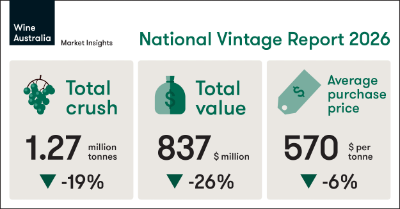
Australia’s 2026 winegrape crush fell 19% to 1.27 million tonnes, the smallest crop since 2000. Despite lower supply, the average value of purchased grapes declined 6% to AUD 570 per tonne, indicating continued weak demand.
National crush drops 19%
Australia’s wine industry processed an estimated 1.27 million tonnes of grapes in 2026, its smallest crush since 2000, according to Wine Australia’s National Vintage Report 2026. The total was about 300,000 tonnes, or 19%, below the 2025 vintage and 25% under the 10-year average of 1.69 million tonnes.
Wine Australia estimated that the year-on-year reduction was equivalent to around 33 million fewer 9-litre cases of wine. The decline reflected a combination of seasonal disruption, including flooding in inland regions, and deliberate reductions by producers responding to weaker consumer demand. It was the fourth consecutive vintage below the long-term average.
The contraction was distributed relatively evenly across Australian states and major wine regions. Wine Australia said global market conditions were affecting both warm inland districts and cool or temperate regions, despite differences in their grape specifications, weather exposure and customer bases.
Red varieties account for most of the decline
Red grapes represented 80% of the annual reduction. Their crush declined by 243,560 tonnes, or 29%, from 2025 and reached its lowest level since 2000. The white-grape crush fell by a smaller 62,774 tonnes, or 9%, lifting white varieties’ share of the national total by 6 percentage points to 53%.
This was only the second time in 12 years that white grapes accounted for a majority of Australia’s crush. Wine Australia Market Insights Manager Peter Bailey linked the change to global consumption patterns. Citing IWSR data, he said global red-wine consumption had declined at twice the rate of white wine since 2017 and was nearly 450 million cases below its level in that year.
The changing mix is important for wineries, grape growers and international buyers. Australian demand for red grapes has contracted more sharply than demand for whites, while the growing share of white varieties may affect future wine availability, export portfolios and vineyard planting decisions.
Lower supply fails to support grape prices
The average value of purchased grapes fell 6% from 2025 to AUD 570 per tonne, even though the national crop was exceptionally small. Values decreased in warm inland and cool or temperate regions and for both colour categories. Cool or temperate red and white grapes were each down 3%; warm inland reds declined 1%, while warm inland whites dropped 12%.
Wine Australia said the lack of price improvement suggested demand remained very soft. The smaller harvest is expected to reduce pressure from wine inventories, but current domestic and export sales total around 1 billion litres, equivalent to approximately 1.4 million tonnes of grapes. Bailey said that volume could probably be supplied from less than 100,000 hectares of vineyards, about two-thirds of the estimated current supply base. He also warned against excessive vineyard removals because reliable national data on plantings and removals are not yet available. The report was based on responses from 667 businesses and was estimated to cover 87% of the Australian crush.