Asia's seaborne thermal coal market enters contraction as Hormuz risk extends coal's role
Asia's seaborne thermal coal market has entered a contraction phase, with demand and supply both easing, according to a Reuters analysis cited by the Korea Economic Daily. Supply is expected to decline slightly faster than demand, keeping prices relatively stable. Asia accounts for about 90% of global seaborne thermal coal trade, while risk around the Strait of Hormuz is extending coal's operating life.
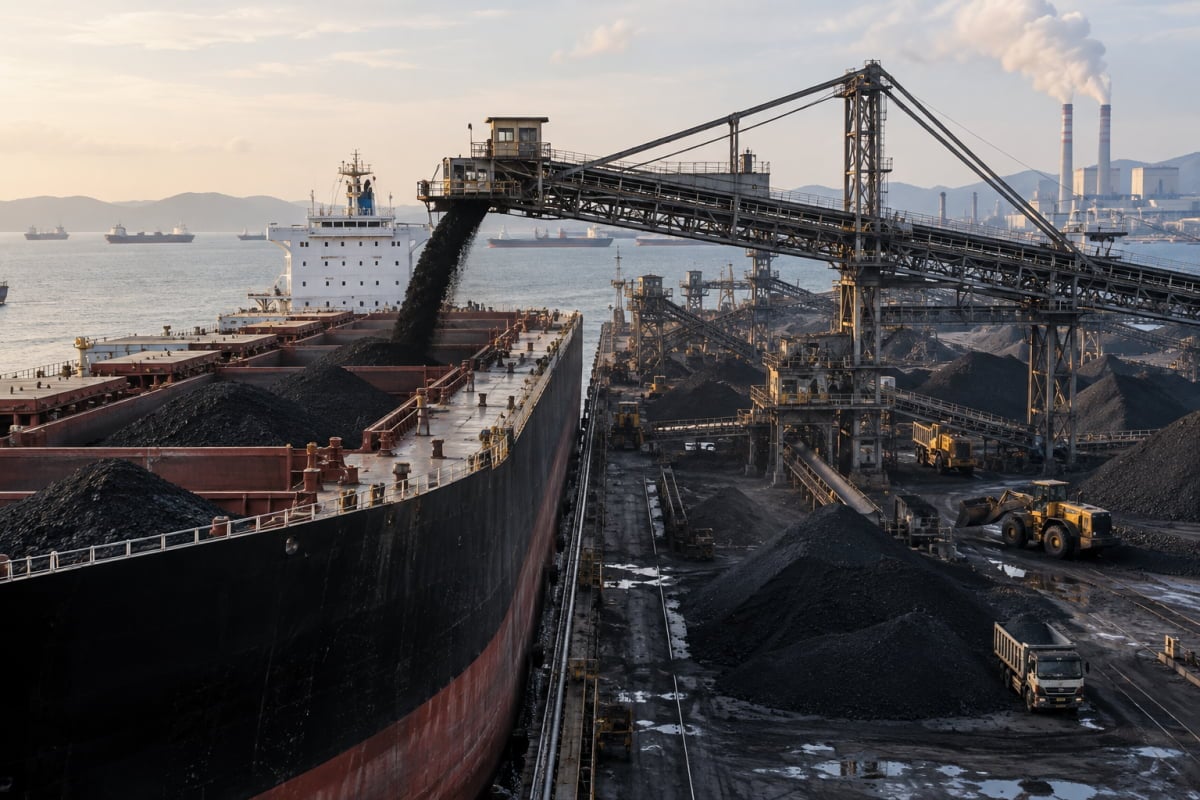
Asia's seaborne power-coal trade turns down
Asia's seaborne thermal coal market has moved into a contraction phase, with demand and supply both declining gradually, according to a Reuters analysis cited by the Korea Economic Daily on 1 October. The same assessment expects supply to fall slightly faster than demand, an imbalance that should keep coal prices relatively stable even as traded volumes shrink.
One figure explains why this matters well beyond Asia. Reuters reported that Asia has accounted for about 90% of global seaborne thermal coal trade in recent years. With roughly nine out of every ten tonnes of internationally traded power coal moving to Asian buyers, a contraction in Asian consumption is in practice a contraction in the world market, and it sets the tone for loadings, freight bookings and term negotiations across the Pacific basin.
For producers and traders the central point of the analysis is the difference between a shrinking market and a falling market. Volumes and prices are moving independently: the business is getting smaller, but the price signal is not breaking down, because export availability is being withdrawn at least as quickly as burn rates decline.
Prices hold while volumes fall
A balance in which supply leads the decline removes the usual consequence of weaker demand. In most commodity downturns, falling consumption meets inherited capacity and prices absorb the gap. Here the published assessment points the other way: with mine output and shipped tonnage retreating in step with, or slightly ahead of, demand, the market clears at broadly stable levels rather than through a price correction.
The published summary does not quantify the expected decline in either demand or supply, and does not identify which exporting countries drive it. Indonesia and Australia are the dominant suppliers of seaborne thermal coal to Asian buyers, and any sustained supply-side discipline would have to be visible in their export programmes first.
The implications differ sharply by position. Mining companies with producing assets face a market that still generates cash but offers little justification for new capacity or long-lived expansions, since the volume outlook is contracting rather than growing. Importers and utilities lose the compensation they normally get in a shrinking market, namely cheaper fuel: planning next year's coal burn around lower prices is not supported by this balance. Traders face thinner volumes with less directional price movement to work with.
Hormuz risk extends coal's operating life
The second element in the analysis is geopolitical. The Korea Economic Daily framed the story around a Hormuz shock that extends the lifespan of coal while Asian supply and demand both recede. Tension around the Strait of Hormuz raises the perceived risk attached to energy cargoes that transit it, and in Asian power generation gas is the fuel most directly exposed, because liquefied natural gas competes with coal for the same generation hours.
Utilities that cannot treat gas deliveries as fully reliable have a reason to keep coal-fired units available, to hold working inventories and to delay closures. That security-of-supply logic pulls against the volume decline described above. It slows the retirement of coal capacity without reversing the overall contraction, which is why the analysis describes a market that is simultaneously shrinking and buying itself more time.
What to watch
- Whether supply discipline holds: prices stay stable only while export availability falls at least as fast as demand.
- Shipping risk around the Strait of Hormuz and any effect on Asian gas deliveries, the main channel through which coal demand is being extended.
- Contracting behaviour by Asian utilities, term versus spot, in a market where a sustained price slide is not the base case.
- Capital decisions at export-focused mines, where contraction combined with stable prices favours running existing assets over building new ones.