Aging rubber estates push Vietnam toward plantation renewal and industrial land conversion
More than 55% of Vietnam’s producing rubber area is over 22 years old, limiting near-term supply growth and accelerating plantation liquidation. Rubber companies are also pursuing industrial-park projects as Vietnam plans to reduce total rubber area by 2030.
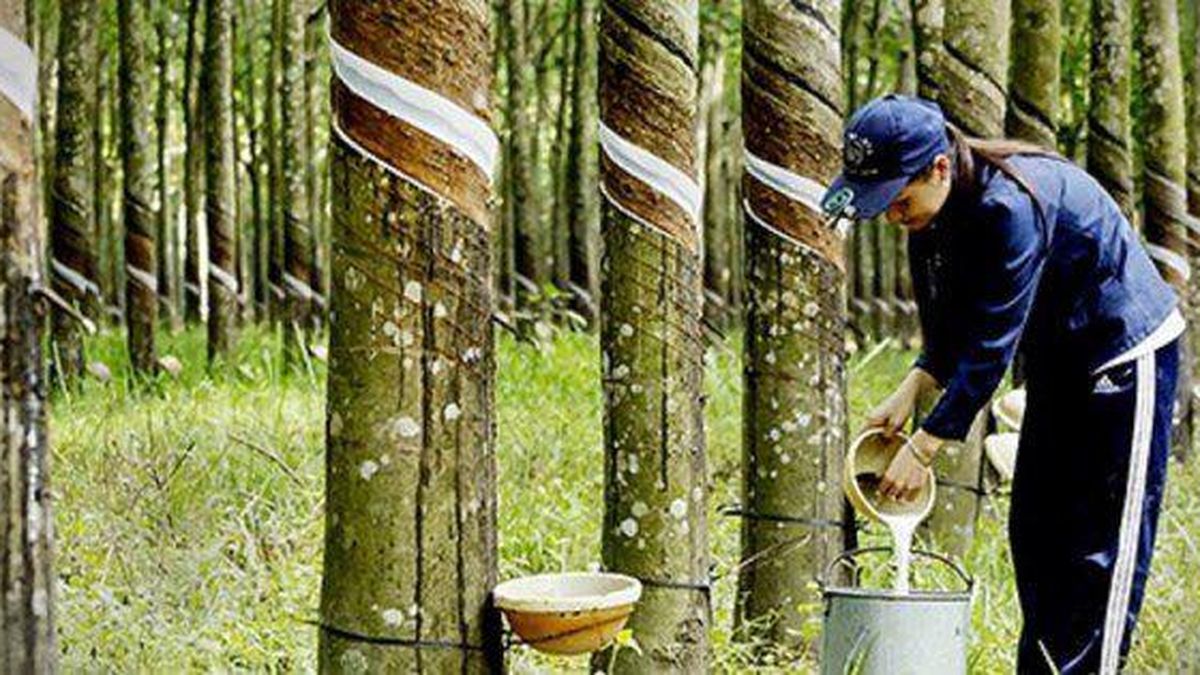
Aging estates constrain rubber supply
Vietnam’s rubber industry is approaching a major renewal cycle, with more than 55% of the area currently under tapping already over 22 years old. KAFI Securities estimates that 409,382 hectares fall into this age category. As companies liquidate aging plantations, the long replanting cycle will restrict how quickly new trees can replace lost output.
Vietnam accounts for around 8-9% of global natural rubber production and is the world’s third-largest rubber exporter, according to KAFI. Domestic latex production has already begun growing more slowly since 2023. Under Decision 431/QD-BNN-TT dated January 26, 2024, the country’s rubber area is expected to decline by about 6-12% from its 2024 level to 800,000-850,000 hectares by 2030, while annual raw latex output is targeted at 1.3-1.5 million tonnes.
China drives natural rubber exports
The composition of Vietnamese rubber exports is changing. Pure natural rubber’s share has fallen from around 45% to 35%, while mixed rubber has gained importance. China now receives 40-45% of Vietnam’s natural rubber exports. Shipments to China have increased strongly, whereas volumes sent to other markets have remained broadly unchanged, making Chinese demand the principal source of recent export growth.
Slow production growth and shrinking planted area could support rubber prices if global demand remains stable. The tyre sector provides a relatively steady demand base: KAFI calculates that global vehicle sales have recorded a compound annual growth rate of about 1.73% since 2009. However, Vietnamese tyre manufacturers face uneven prospects as the market moves from bias tyres toward radial products and tyres designed for electric vehicles.
Industrial parks offer an alternative return
Plantation liquidation is also releasing land for higher-value uses. Rubber companies are considering industrial parks in areas with large estates and expanding manufacturing activity, including Tay Ninh, northern Binh Duong and eastern Dong Nai. Projects expected to advance through legal and compensation procedures during 2026-2027 cover approximately 2,874 hectares.
The pipeline includes the 483-hectare second phase of Minh Hung III and the Long Duc and Bau Can projects associated with Vietnam Rubber Group, or GVR. Tay Ninh Rubber has the 496-hectare Hiep Thanh and 500-hectare Thanh Duc I projects. Phuoc Hoa Rubber’s projects include 704-hectare Bac Tan Uyen 1 and 691-hectare VSIP III. KAFI estimates that GVR controls about 23,444 hectares that could be converted into industrial parks during 2025-2030.
National planning calls for industrial-park land to reach around 210,930 hectares by 2030. Estimated rubber-land conversions during 2026-2030 include about 5,183 hectares in Ho Chi Minh City, 2,000 hectares in Dong Nai and 3,260 hectares in Tay Ninh. Conversions remain dependent on approvals and compensation, so their timing and financial contribution will vary by company.
Operators with productive estates can continue benefiting from rubber. Dong Phu Rubber reports yields above 2 tonnes per hectare, compared with an industry average of about 1.8 tonnes. Its industrial projects are unlikely to contribute materially in the short term because legal procedures are still being completed. The sector is therefore splitting into two investment cases: maintaining efficient latex production on stronger estates and monetising selected aging plantations through land conversion.